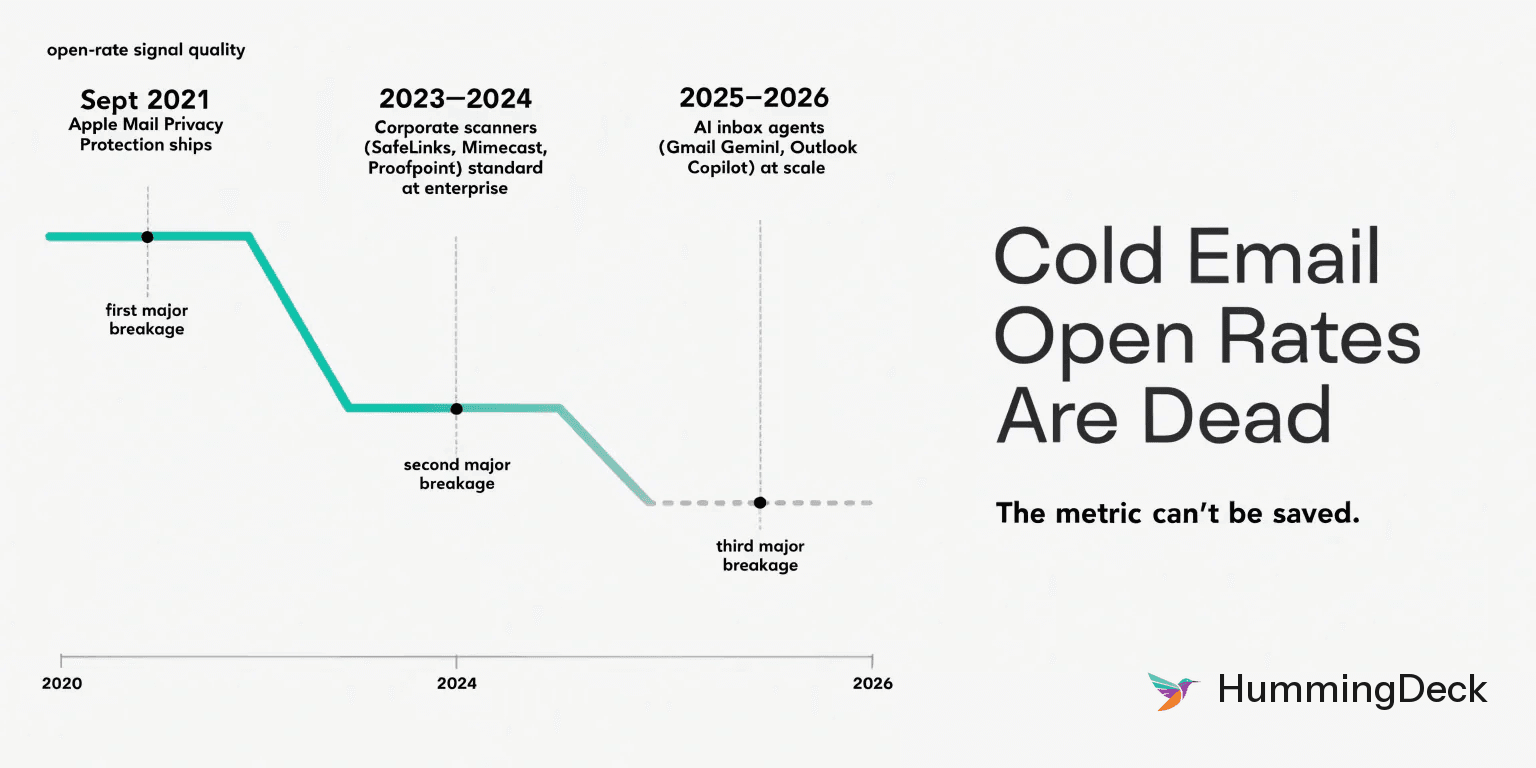
Cold Email Open Rates Are Dead. The Metric Can't Be Saved.
Apple MPP, corporate security scanners, and AI inbox agents broke the open-rate proxy in 2026. Filtering doesn't fix it. Here's what still works and what to measure instead.

Insights on sales engagement, document tracking, and closing more deals.
Apple MPP, corporate security scanners, and AI inbox agents broke the open-rate proxy in 2026. Filtering doesn't fix it. Here's what still works and what to measure instead.

Per-investor tracking across deck, financials, and cap table in one branded link. Compare lean data rooms under $50/mo. May 2026 update.
See what each investor read, not aggregate firm-level pings. Per-stakeholder tracking and forwarding detection for fundraising decks.
See which clauses clients pause on, when they return to re-read, and how to time follow-ups. 7 alternatives ranked. May 2026 update.
A step-by-step walkthrough of letting buyers accept, request changes, or decline your proposal directly inside the viewer, with full audit trail and instant notifications. No DocuSign, no separate signing tool.
Most dead-lead posts chase time-based cadences or wait for funding announcements. The signal that actually predicts revival, a prospect re-opening the deck you sent two months ago, sits in every sales stack but runs through none of them.

Most sales proposals don't need a legally binding e-signature. They need a clear accept-or-decline mechanism with an audit trail. Here's the honest map of when DocuSign earns its cost, when a tracked-link approval is genuinely better, and how to tell the difference.
A step-by-step walkthrough of bulk-generating per-prospect tracked links from a CSV: upload, map columns, generate, export. Per-recipient attribution that makes engagement-triggered followup possible at outbound scale.
The MQL broke. How to measure Market Engaged on top of Jon Miller's MEX framework: specific thresholds, a 7-step playbook, and Palo Alto Networks' 17% win-rate case study.

Replies are the metric you measure. Engagement is the metric you act on. A practical re-orientation of the cold outbound funnel that compresses the cycle from weeks to hours, by calling the cohort that actually engaged with the content you sent.
How to send your pitch deck to investors in 2026: real VC quotes, founder-tested email templates, the data room workflow, and what to send with it.
Pitch deck analytics for founders: track which investors open your deck, how long they spend per slide, and who forwarded it. Set up in 5 minutes, filter bot opens, follow up based on real signals.
Per-slide read time, return visits, and the forwarding signal that reveals when partners are reviewing. May 2026 benchmarks from HD's data.

Every signal-based selling framework defines signals as pre-outreach: funding rounds, hiring, intent surges. None account for what happens after you send the proposal. Here's what's missing.

The sales velocity formula is a reporting metric for most teams. But content engagement data from your shared proposals turns it into an operational lever. Here's the math.
Your intent platform tells you which accounts are surging. But the strongest buying signals come from how prospects engage with the proposals and decks you already sent them.
Every vendor defines first-party intent data as website behavior. But the highest-fidelity buying signals come from content you share directly with prospects — and nobody includes them in the conversation.
Most MEDDIC scorecards are filled with rep intuition, not evidence. Here's how document engagement data validates Champion, Economic Buyer, Decision Process, and more.

Budget, Authority, and Need are assessable. Timing has always been a guess. Here's how to measure it with content engagement data.

Your cold email tool tracks the email. Here's how to track what happens after the click — page-by-page engagement, forwarding, return visits, and bot filtering.
Per-page time, return visits, forwarding signals: what proposal trackers actually surface. DocSend vs PandaDoc vs HummingDeck and 5 others. May 2026.
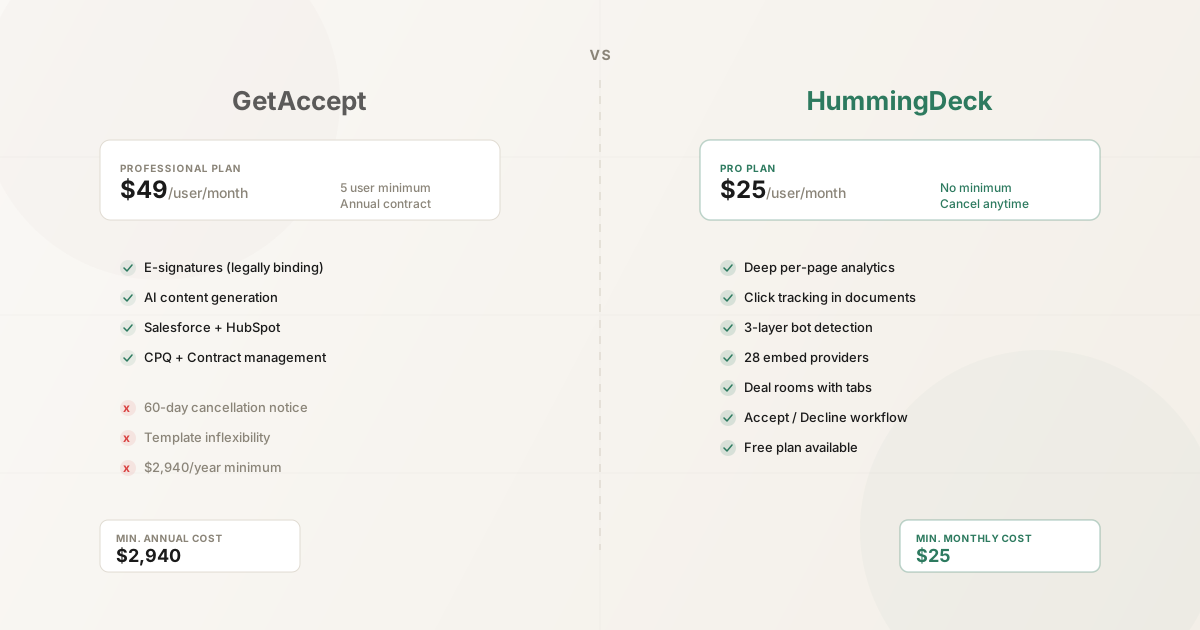
GetAccept is powerful but costs $49/user/month with a 5-user minimum and annual lock-in. Here's when HummingDeck is the more practical alternative for deal rooms, document sharing, and engagement analytics.
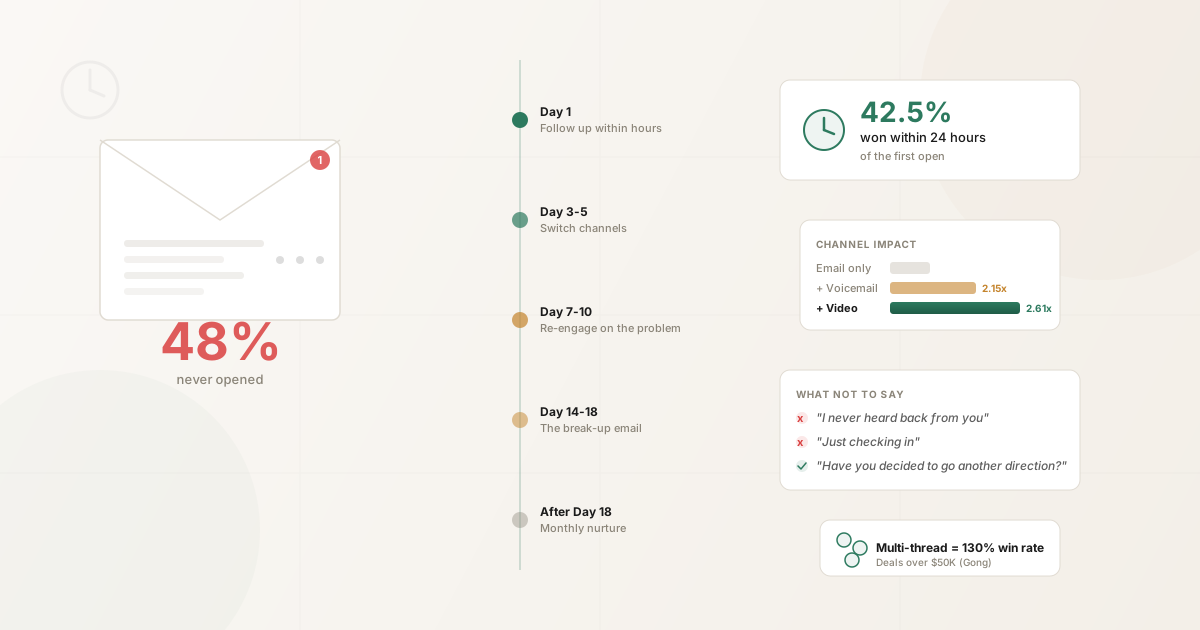
48% of deal rooms never get opened. 86% of B2B purchases stall. Here's what the research actually says about proposal follow-up timing, why prospects go silent, and the multi-channel cadence that recovers dead deals.
Seven DocSend alternatives compared by free plan, per-page analytics, bot filtering, and use-case fit. Includes the founder-vs-sales-team distinction DocSend's pricing increase made urgent in 2026.
Most DSRs are built for enterprise. Here's a feature-by-feature audit of what small teams actually need — and what's overkill for straightforward deals.

Proposal management software creates proposals. Tracking software shows who opened them. Here's how they compare and how to pick the right one for your team.

48% of deal rooms never get a single buyer view. Here's why — and what separates the rooms that work from the ones nobody opens.
We tested read receipts in Gmail, Outlook, and Apple Mail. One worked sometimes. Two failed completely. Here's what we found and the one method that always works.
See if your prospect viewed your proposal, which pages they read, how long they spent, and when they came back — with per-page engagement analytics.

Every way to share a presentation online — from email attachments to tracked links — with the pros, cons, and best use case for each method.
A digital sales room replaces scattered email attachments with a single tracked link. Here's how DSRs work, what they cost, and whether your team needs one.
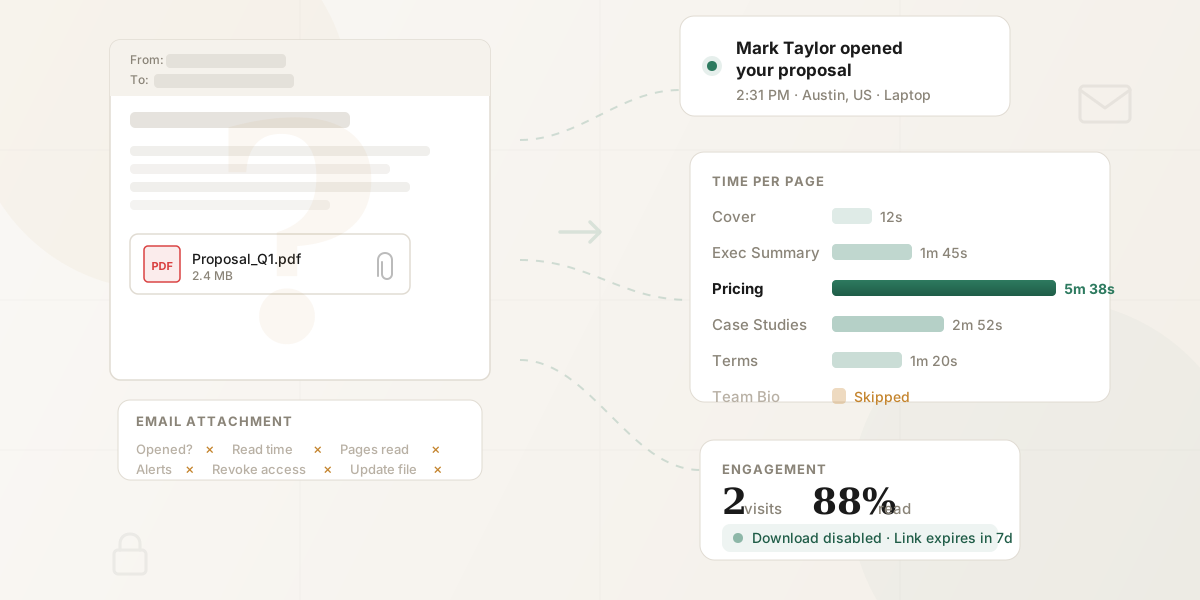
Email attachments can't be tracked directly — but tracked links capture every open, every page, and seconds spent on each. Swap attachments for tracked PDFs in under 2 minutes.
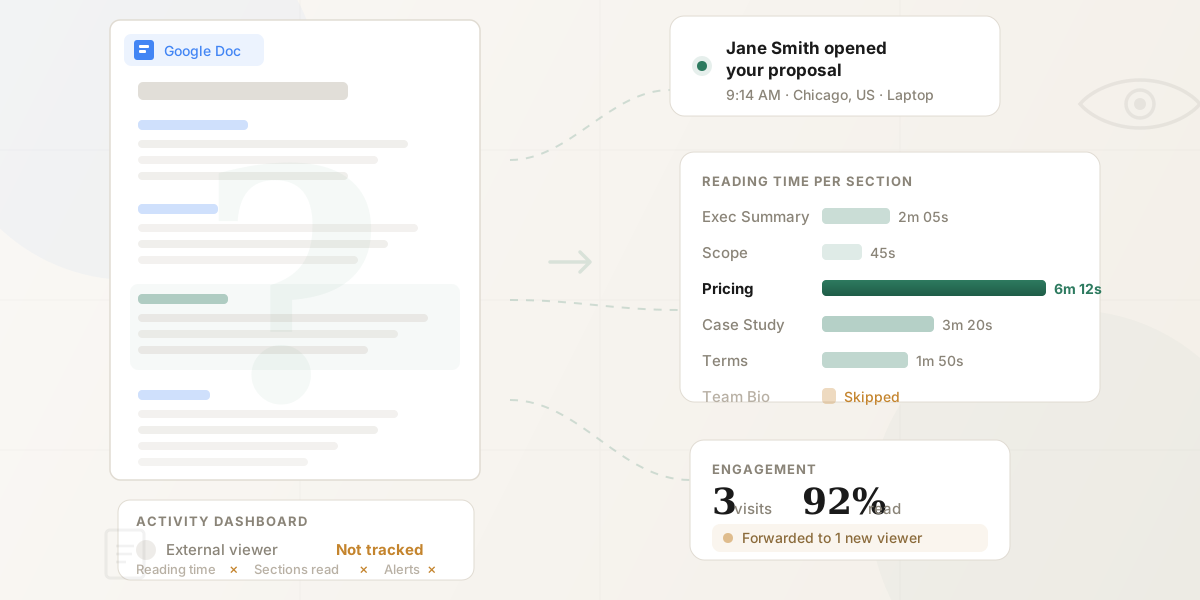
See exactly who opened your Google Doc, how long they spent on each page, and whether they shared it. Works for external viewers — not just your Workspace team.
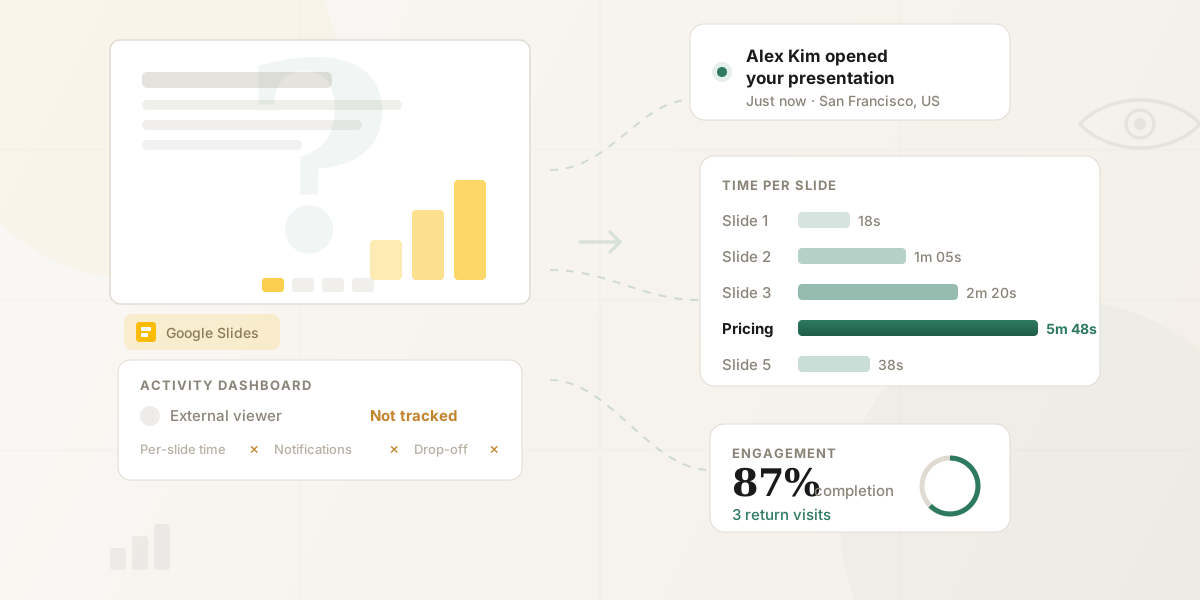
Google Slides only tracks viewers within your own Workspace — externally shared presentations show nothing. Here's how to track external viewers, time-per-slide, and downloads in under 2 minutes.
We tested 7 digital sales room platforms side by side. Actual pricing (not 'contact us'), real feature gaps, and which ones work for teams under 20.

Digital sales rooms aren't just for sellers. See how HR, agencies, real estate, fundraising, and consulting teams use deal rooms to track document engagement and close faster.

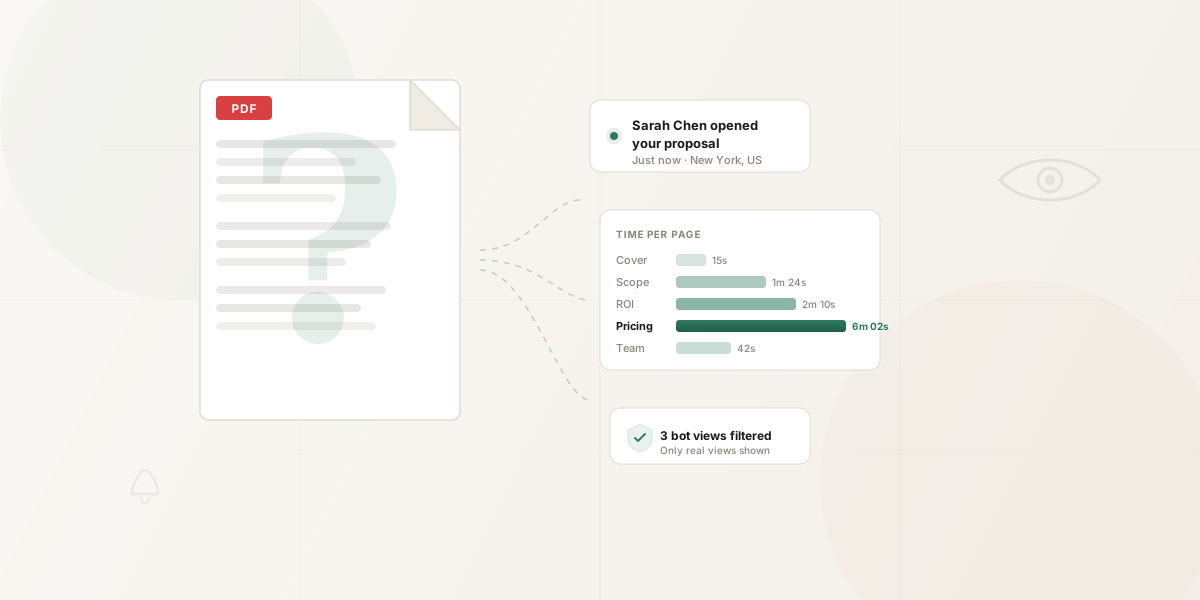
You sent a PDF and heard nothing back. Here are 6 ways to find out if they opened it — including one that shows you which pages they read and how long they spent on each.
Downloads don't tell you who's interested. Learn 5 methods to track what happens after someone downloads your lead magnet — from UTM tags to per-page analytics.
5 ways to know if a prospect actually read your proposal — not just opened the email. From read receipts to per-page engagement tracking.

Corporate scanners (SafeLinks, Proofpoint, Mimecast) pre-open every link before your prospect does, inflating both cold email clicks and deck view counts. Here's the three-layer bot-filtering system we built.
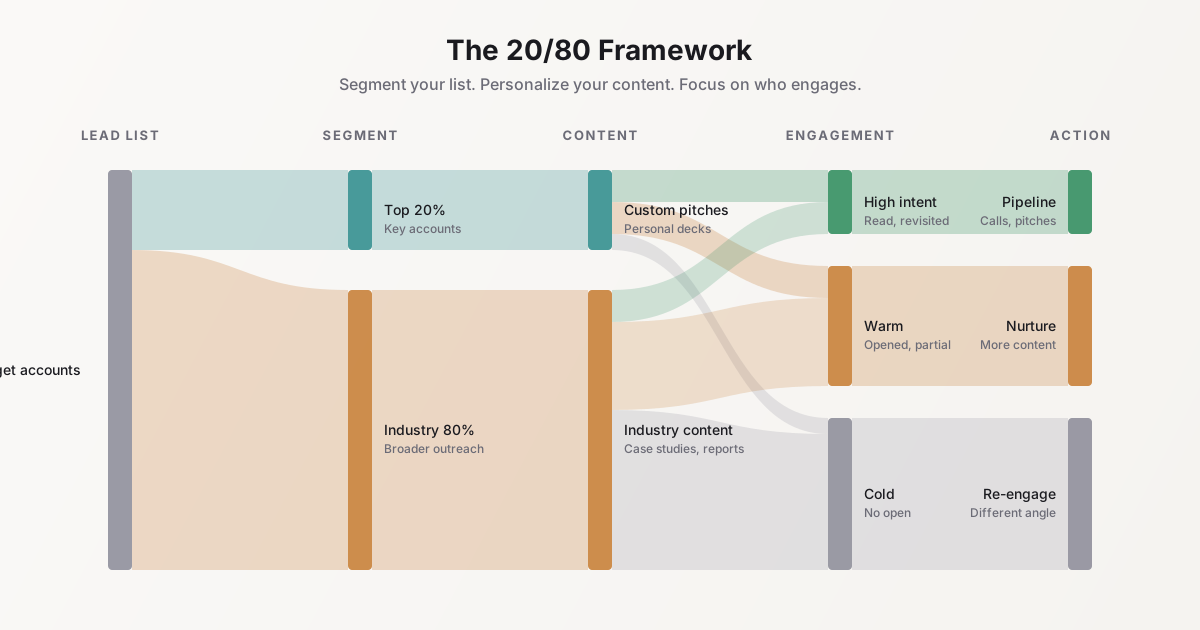
Not all prospects deserve the same effort. The 20/80 framework splits your list into high-value accounts that get deep personalization and the rest that get industry-relevant content — then uses engagement signals to tell you who's actually interested.
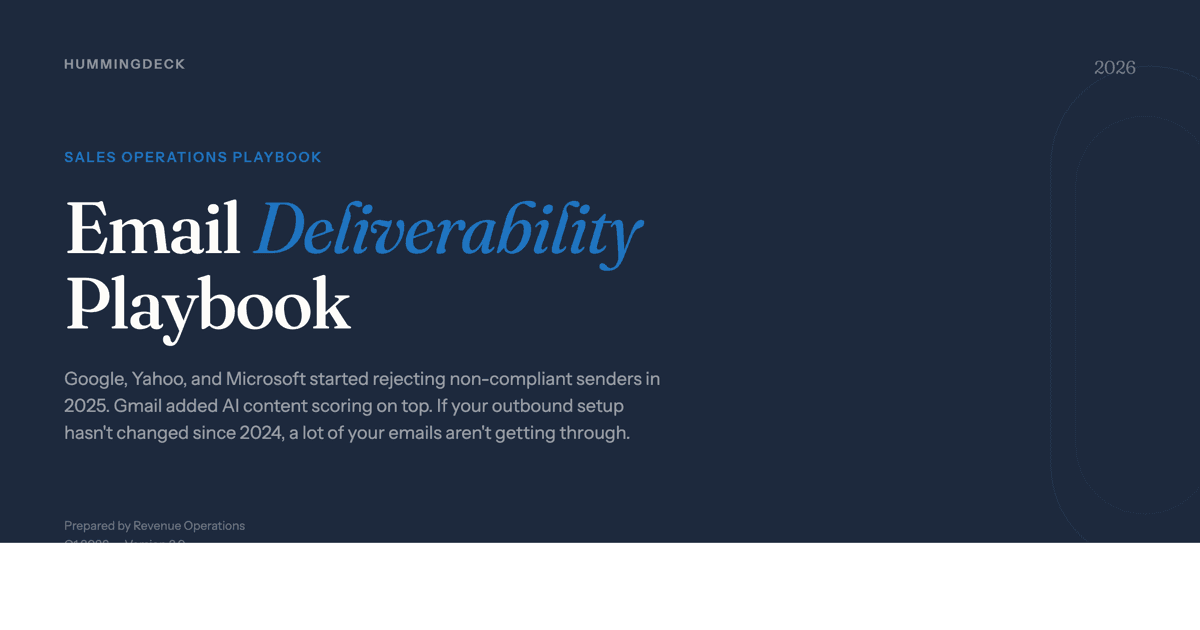
Google, Yahoo, and Microsoft now reject non-compliant senders outright. Here's what changed in 2025–2026 — authentication, domain setup, AI filters, and what to track instead of opens.

Cold outreach is collapsing. The reps who are winning are creating content, sharing it with prospects, and using engagement signals to focus on who's actually interested. We call it content-led prospecting.
HummingDeck now sends rich Slack notifications the moment a prospect opens your sales deck. Learn how to set it up in a few clicks.
Introducing HummingDeck — the smarter way to share sales decks and track prospect engagement in real-time.