You sent the proposal. It's been four days. No reply, no view notification, nothing. You're now stuck in the most expensive limbo in B2B sales — not knowing whether to follow up, wait, or move on.
Here's the uncomfortable truth: this happens to nearly half of all proposals sent. And the cost isn't just one lost deal — it's the compounding effect of reps spending weeks chasing prospects who went dark while live opportunities sit neglected.
We dug into the research — across 1.3 million proposals (Proposify), 1.8 million opportunities (Gong), 200 million sales interactions (Salesloft), and multiple independent studies — to find out what actually works. The answers are sharper, and stranger, than the generic "follow up 3–5 times" advice that dominates Google.
Short on time?
Skip to the follow-up cadence that top performers use, or the what not to say section to avoid the most common mistakes.
How big is the ghosting problem, really?
The scale is worse than most teams realize.
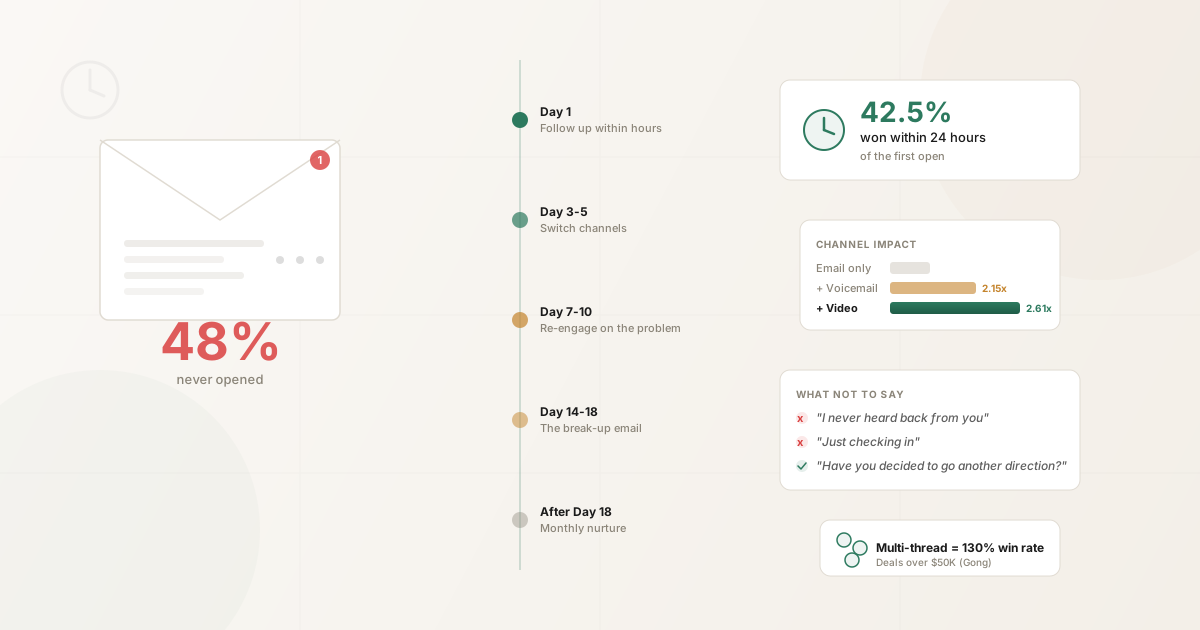
Flowla analyzed 30,000+ digital sales rooms and found that roughly 48% never receive any buyer engagement at all (Flowla, "State of Digital Sales Rooms in 2026"). Nearly half of the carefully prepared deal materials that sales teams create go completely unviewed.
But the problem runs deeper than unopened proposals. Forrester's 2024 State of Business Buying report found that 86% of B2B purchases stall at some point during the buying process. And when deals do die, they usually don't lose to a competitor — research from the Jolt Effect (Matt Dixon) and Gartner converge on the same finding: over 40% of qualified pipeline is lost to "no decision." Your prospect didn't choose someone else. They chose to do nothing.
Meanwhile, the average B2B company takes 42 hours to respond to a new lead (MIT/HBR audit of 2,241 US firms). Independent studies by RevenueHero (29 hours) and Optifai (47 hours) put the figure in a similar range. Call it roughly two business days — an eternity when the data shows that speed is the single strongest predictor of whether a deal closes.
The gap between how fast buyers expect a response and how slowly sellers deliver one is where proposals go to die.
Why prospects actually ghost (it's not what you think)
The default assumption is personal: they didn't like your proposal, your pricing was too high, you said something wrong in the last meeting. Sometimes that's true. But the research points to a more structural problem.
The committee problem
B2B buying committees have grown dramatically. Gartner's 2024–2025 research puts the average at 6–10 decision-makers, with many deals involving 11 or more. Forrester goes further: 13 stakeholders on average, spanning multiple departments in 89% of purchases. 6Sense (2025) estimates teams of about 10 people.
The trend line is clear — from roughly 5.4 buyers per deal in 2015 to 10–13+ today.
Here's why this matters for ghosting: 74% of buying teams experience "unhealthy conflict" during the decision process (Gartner 2025). Your champion may love your proposal. But they need sign-off from procurement, legal, their VP, and two peer departments — and any one of those stakeholders can stall the process indefinitely by simply not responding to an internal email.
When your prospect goes dark, it's often not because they lost interest. It's because they're fighting an internal battle they can't tell you about.
The real reasons, ranked
Based on practitioner consensus across sales communities and confirmed by the research:
- They're overwhelmed. Your proposal isn't competing with other proposals — it's competing with everything else on their plate. Your priority is not their priority.
- Internal politics. A hidden decision-maker who wasn't in your early conversations now controls approval. Your champion is stuck waiting for someone they can't rush.
- Price shock. They saw the number and need time to process — or build internal justification. This isn't necessarily a "no," but it creates a pause that feels like silence.
- Fear of saying no. Confrontation avoidance is real. As sales consultant Jim Keenan observes: "The longer it goes without response, the more they feel bad about it, and in an odd twist, the less likely they will be to call." Guilt compounds silence.
- They were benchmarking you. They needed three quotes for procurement. You were quote number three. They were never going to buy, but telling you that felt harder than ignoring you.
The guilt spiral
HubSpot's Jeff Hoffman warns: "Don't call attention to their silence — you just make them feel guilty, and what do people do when they feel guilty? Avoid the situation." The instinct to say "I haven't heard back" is exactly wrong. It makes the silence worse, not better.
The 24-hour window most reps miss
Proposify's analysis of 1.3 million proposals surfaced a stat that should reshape how every sales team thinks about follow-up timing:
42.5% of all closed-won proposals are won within 24 hours of the first open.
Read that again. Nearly half of all deals that close successfully do so within one day of the buyer first engaging with the proposal. The window between "they opened it" and "they decided" is dramatically shorter than most reps assume.
This aligns with the MIT/InsideSales lead response study (Dr. James Oldroyd, 15,000+ leads): responding within 5 minutes versus 30 minutes makes you 21x more likely to qualify the lead and 100x more likely to make contact. And 78% of customers buy from the first company that responds to their inquiry.
The implication is clear: the moment a prospect engages with your proposal is the highest-leverage moment in the entire deal. If you don't have real-time engagement tracking telling you when someone opens your document, you're flying blind through the most important window.
Proposify also found that winning proposals are viewed an average of 2.5 times before closing, while unsuccessful proposals are viewed 3.5 times. More views doesn't mean more interest — it means more friction, more indecision, more internal back-and-forth. A decisive buyer reads it twice and signs.
The data-backed follow-up cadence
The generic advice — "follow up 3–5 times" — is directionally correct but operationally useless. Here's what the data actually supports, synthesized from Gong, Salesloft, Proposify, and practitioner consensus.
Day 1: Follow up within hours of engagement
If you have tracking data showing the prospect opened your proposal, follow up the same day — but give them at least an hour to finish reading. Don't call while they're literally on page 4.
If you don't have tracking data, follow up the day after sending. The first follow-up should add value, not ask a question. Reference something specific: "I wanted to flag the ROI model on page 6 — the numbers are based on averages, but I can customize them to your actual metrics."
Days 3–5: Switch channels
This is where most reps stall. They send a second email that sounds like the first one, wait another week, send a third, and give up.
The data says: switch channels. Salesloft's analysis of 200M+ sales interactions found that incorporating video or direct mail into cadences increases success rate by 161%. Video alone boosts email reply rates by 25%. And Gong's study of 304,174 emails found that leaving a voicemail increases email reply rate from 2.73% to 5.87% — more than doubling it.
The follow-up at day 3–5 should be a phone call, a LinkedIn message, or a short video message — not another email. As practitioner Sam Wakefield puts it: "Switch to text messages. That is a level of familiarity that people have with you."
Days 7–10: Re-engage on the problem, not the proposal
If you've gotten no response to your first two touches, the proposal framing didn't land. Don't send it again. Re-engage on the underlying problem.
"I've been thinking more about [their specific challenge]. One thing I didn't include in the proposal was [additional insight]. Worth a quick conversation?"
Salesloft's data shows that reply rates increase 2.75x when emails contain at least 15% personalization versus zero. Generic "just checking in" emails are the lowest-performing follow-up in every dataset.
Days 14–18: The break-up email
This is the most counterintuitive tactic in the research — and it works. Sales trainer Sam Wakefield's "go for the no" technique: ask "Have you decided to go a different direction on this?" or "Have you given up on this project?"
The psychology is simple. Saying "no" feels definitive and uncomfortable. Most prospects respond to defend their intent: "No, we haven't given up — we've just been swamped." That response reopens the conversation.
Gong's data supports the inverse: saying "I never heard back from you" increases reply rates but decreases meetings booked by 14%. The guilt approach gets a response but poisons the tone. The "go for the no" approach gets a response and preserves the relationship.
After day 18: Monthly or quarterly nurture
If four touches across multiple channels haven't produced a response, shift to long-term nurture. A monthly value-add — a relevant article, a new case study, an industry benchmark — keeps you visible without pressure.
PandaDoc's analysis of 570,000+ proposals found that sending a series of reminders makes you 30% more likely to close. Persistence matters. But persistence without channel switching and personalization is just spam.
The prevention tactic
The strongest signal from practitioner communities: never send a proposal without a booked follow-up meeting. Gini Dietrich (Spin Sucks): "Schedule a meeting to walk them through the proposal versus sending it. This works every, single time." If you book the walkthrough before you send, ghosting becomes structurally impossible — they'd have to cancel a meeting, which is psychologically harder than ignoring an email.
What not to say: the phrases that kill deals
Not all follow-ups are equal. Gong's analysis of 304,174 emails identified specific patterns that hurt more than they help.
"I never heard back from you" — increases reply rates (people feel guilty) but decreases meetings booked by 14%. You get a response, but it's defensive, not constructive. The prospect engages to relieve guilt, not to advance the deal.
"Just checking in" / "Just following up" — the data consistently shows these are the lowest-performing opening lines in follow-up emails. They add zero value and signal that you have nothing new to offer.
Automated template emails — Gong found that manual emails consistently outperform automated emails on engagement. Prospects can tell the difference. If your follow-up reads like it was generated by a sequence, it performs like one.
Morning emails — counterintuitively, Gong's data shows that afternoon emails get higher reply rates than morning sends. The morning inbox is the most crowded; by afternoon, the prospect has cleared the urgent items and has bandwidth to consider your proposal.
The multi-threading imperative
This is the single most important structural change you can make to prevent ghosting — and the data is unambiguous.
Gong's analysis of 1.8 million opportunities found that multi-threaded deals (those with relationships across multiple stakeholders) close at 130% higher win rates for deals over $50,000. Closed-won deals have 2x as many buyer contacts as lost deals. Won deals involve 8 email contact points versus 3 for lost deals.
For deals between $50K and $250K, winning deals involve at least 10 stakeholders. Strategic deals average 17 contacts.
The connection to ghosting is direct: if your entire deal runs through a single contact, and that contact goes dark — for any reason: vacation, job change, internal politics, overwhelm — the deal dies. There's no one else to call. Multi-threading is insurance against ghosting.
Practically, this means:
- Ask your champion who else will be involved in the decision before you send the proposal
- Use a digital sales room or tracked link with document analytics that shows you when new viewers access your materials — each new viewer is a thread you can pull
- When you see a second viewer from the same company, reach out to your champion: "I noticed your team has been reviewing the proposal — would it be helpful to set up a walkthrough for the group?"
- Offer supporting materials that are easy to forward internally: a one-page summary, a comparison table, an ROI calculator
When to walk away
Not every silent prospect is a future customer. The data helps you distinguish between "stuck" and "done."
Walk-away signals:
- Zero views after two re-engagement attempts across different channels
- Proposal opened once, under 30% completion, no return visit
- No response to a direct "have you decided to go a different direction?" message
Stay-engaged signals:
- Multiple viewers from the same company (internal evaluation is happening)
- Return visits to specific sections, especially pricing (they're building a case)
- Partial engagement followed by silence (they got stuck on something specific)
Proposify's data offers a useful heuristic: proposals viewed 2–3 times are in the healthy decision zone. Proposals viewed 3.5+ times without closing signal friction, not interest — the buyer is going in circles.
Walking away isn't giving up. It's redirecting energy toward the deals where engagement data shows active buyer interest. Without proposal tracking, you can't make this distinction — so you either over-invest in dead deals or under-invest in live ones.
FAQ
How long should I wait before following up on a proposal?
If you have engagement tracking and can see when the prospect opens your proposal, follow up within a few hours of that first view — but give them time to finish reading. If you don't have tracking data, follow up the day after sending. The research consistently shows that speed matters: 42.5% of won proposals close within 24 hours of the first open (Proposify, 1.3M proposals analyzed).
How many times should I follow up on a proposal?
The data supports 4–5 touches across multiple channels over 2–3 weeks, then shifting to long-term monthly nurture. Only 8% of salespeople make 5+ follow-up touches (Close.com), while 44% give up after just one (HubSpot). The key is that each follow-up should use a different channel (email, phone, LinkedIn, video) and add new value rather than repeating "just checking in."
What's the best day and time to send a follow-up email?
Gong's analysis of 304,174 emails found that afternoon emails get higher reply rates than morning sends — the morning inbox is the most competitive. For the day, most practitioner data points to Tuesday through Thursday. But the most important timing factor isn't day-of-week — it's proximity to the prospect's engagement with your proposal.
Why do prospects ghost after asking for a proposal?
The most common reasons are: internal committee dynamics (74% of buying teams experience "unhealthy conflict" per Gartner), competing priorities that push your deal down the list, price shock that requires time to process or justify internally, and fear of delivering a "no." Over 40% of deals are lost to "no decision" rather than to a competitor — the buyer chose inaction, not someone else.
Should I call or email for a follow-up?
Both — and more. Gong found that leaving a voicemail more than doubles email reply rates (from 2.73% to 5.87%). Salesloft's data shows that multi-channel cadences including video increase success by 161%. The strongest follow-up sequences start with email, then switch to phone or LinkedIn by touch 2–3, and use video or text messaging by touch 4–5.
Is it worth following up on a proposal that was never opened?
Yes, but change your approach. A proposal that was never opened may have landed in spam, gotten buried, or arrived at the wrong time. Re-send the link with a shorter, more specific subject line. Try a different channel entirely. If two re-engagement attempts across different channels produce zero engagement, qualify out and reallocate your time to deals showing active buyer interest.
How do I know if my prospect forwarded my proposal to their team?
Use a document tracking tool that detects new viewers on the same link. When your contact forwards the tracked link internally, each new viewer appears separately — each identified by location and engagement pattern. Multiple unique viewers on one link within a short timeframe is the strongest buying signal in B2B sales, because it means your proposal is being actively evaluated by a group. Share a tracked proposal and tools like HummingDeck show you exactly who's viewing, for how long, and which pages they focus on — with plans starting at $0.