In a previous post, we made the case for content-led prospecting — the idea that sharing valuable content and tracking engagement produces better pipeline than blasting cold emails at scale. The data is clear: volume-based outbound is structurally broken, and the reps who are winning lead with value, not noise.
But a common question follows: "Okay, I'm in. But I have 200 target accounts. I can't write a custom pitch deck for each one."
You're right. You can't. And you shouldn't.
This is where the 20/80 framework comes in.
Short on time?
Jump to the 5-stage framework or see a concrete example of the framework in action.
The Insight: Not All Prospects Deserve the Same Effort
The Pareto principle shows up everywhere in sales. Roughly 80% of revenue comes from 20% of accounts. The top 4% of accounts often represent 64% of total sales. 87% of marketers who measure ROI say account-based approaches outperform every other investment.
Yet most outbound campaigns treat every prospect the same. Same email template, same deck, same follow-up cadence. This is a misallocation of your most valuable resource: your time and attention.
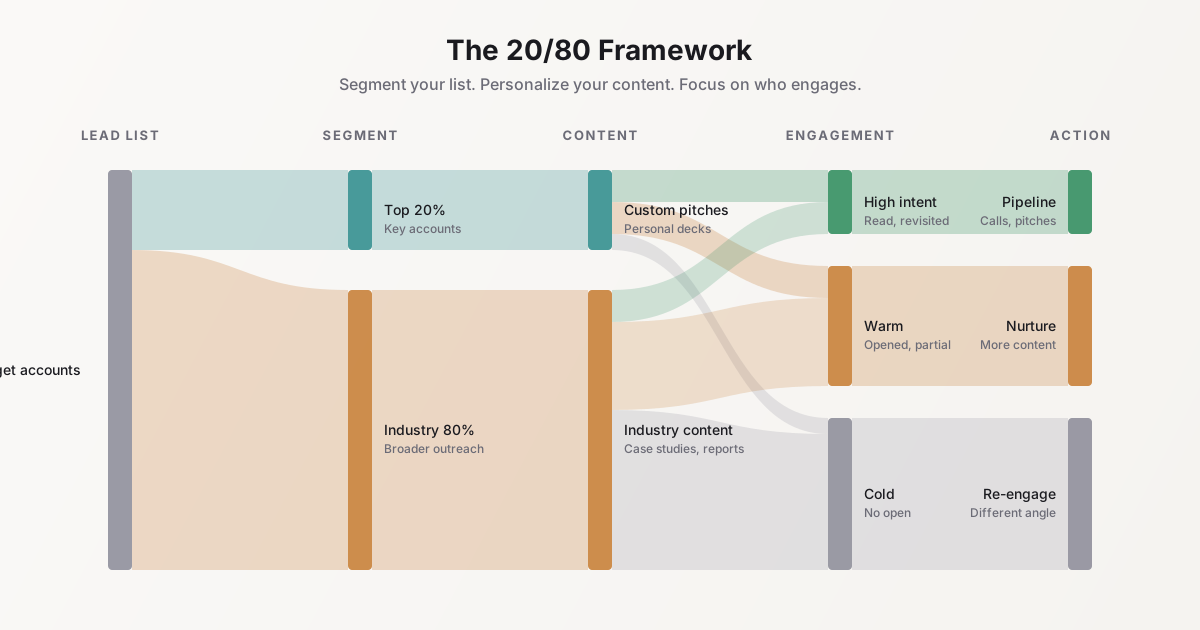
The 20/80 framework fixes this by splitting your list into two segments — each getting a different content strategy — and then using engagement signals to dynamically reprioritize.
The Framework
Here's the full flow, from lead list to pipeline action:
Five stages. One unified campaign. Let's walk through each.
Stage 1: Start With Your List
You have a target list — say, 50 accounts in a specific industry. These might come from a CRM Smart View, a LinkedIn Sales Navigator search, or a manually curated list. The exact source doesn't matter. What matters is that they share an industry or use case.
Stage 2: Segment Into Top 20% and Industry 80%
Before you create any content, split the list.
Top 20% (10 accounts): These are the accounts where the deal potential is highest. You know their challenges, you've researched their org structure, or they've shown prior signals of interest. These accounts justify deep personalization.
Industry 80% (40 accounts): The rest of the list. They fit your ICP, they're in the right industry, but you don't know enough about each one to justify custom work. They get industry-relevant content — not generic, but not bespoke either.
How do you decide who's in the top 20%? Look for:
- Deal size potential. Enterprise accounts with larger budgets.
- Strategic fit. Companies where your product solves a known, urgent problem.
- Existing signals. They've visited your website, engaged on LinkedIn, or been referred.
- Competitive timing. Their current contract is up for renewal, or they've recently changed leadership.
Stage 3: Match Content to Each Segment
This is the core of the framework. Each segment gets different content, created with different levels of effort.
For the top 20% — custom pitches:
- Research each company's specific challenges (10-15 minutes per account)
- Create or customize a pitch deck that addresses their situation
- Reference their recent news, competitors, or strategic priorities
- Each contact gets an individual trackable link
This is where deep personalization pays off. The ROI on spending 30 minutes per top-20% account is enormous compared to spending 30 seconds on a templated email.
For the industry 80% — industry content:
- Create one strong industry asset: a case study, trend report, or competitive analysis
- Make it genuinely useful — something they'd read even if they never buy from you
- Share it with all 40 accounts using company-level or individual trackable links
The content for the 80% isn't filler. 51% of B2B buyers say the content they receive is too generic and irrelevant. A well-researched industry case study is more valuable than a "personalized" email that just swaps in the company name.
Stage 4: Read the Engagement Signals
Here's where content-led prospecting diverges from traditional outbound. Instead of waiting for replies, you watch behavior.
Within a few days, you'll see three groups emerge:
High intent (~16%): These prospects read your content thoroughly, spent significant time on key sections, revisited it, or forwarded it to colleagues. Engagement analytics make these signals visible in real time. This is a strong buying signal — 93% of B2B marketers report higher conversion rates when acting on engagement data.
Warm (~30%): They opened the content, spent some time with it, but didn't finish or come back. There's interest, but not urgency.
Cold (~54%): No open, or a quick bounce. They're not interested right now.
The beauty of this stage: both segments converge. A top-20% account that you spent 30 minutes researching might show zero engagement — cold. An industry-80% account that got a generic case study might read every page and forward it to their VP — high intent. The engagement data overrides your initial assumptions.
Stage 5: Act on What You Learned
Now you know where to focus:
High-intent prospects → pipeline. These get immediate, personal follow-up. Reference what they actually engaged with: "I noticed you spent time on the pricing comparison section — would it be worth a quick call about how that applies to your setup?" Companies that respond within 5 minutes are 7x more likely to qualify a lead than those who wait an hour.
Warm prospects → nurture. Don't hard-sell. Send them another piece of valuable content in a week or two. Build the relationship. They've shown enough interest to stay in the funnel but not enough to justify a direct ask.
Cold prospects → re-engage or park. Don't waste energy. Try a different content angle in a month, or move them to a low-touch sequence. Your attention is better spent on the engaged.
Why This Works Better Than Treating Everyone the Same
The math is straightforward.
Traditional approach: Send 50 identical emails. Get 2-3 replies (4-6% response rate). Book 1 meeting. No visibility into who else was interested but didn't reply.
20/80 framework: Invest deeply in 10 accounts, broadly in 40. Track engagement across all 50. Identify ~8 high-intent prospects — some from your top 20%, some surprises from the 80%. Follow up with real context. Book 3-5 meetings with prospects who are actually interested.
Same list. Same time investment. Radically different results — because you matched your effort to the opportunity and let behavior data guide your follow-up.
The key insight
The 20/80 split is your starting hypothesis. Engagement signals are the correction. Some of your "top 20%" will go cold. Some of your "industry 80%" will light up. The framework gives you a structure to start with and data to adapt from.
Putting It Into Practice
Here's a concrete example. Say you sell a compliance platform to financial services companies.
Your list: 50 mid-market fintech and banking companies.
Top 20% (10 accounts): Companies you know are dealing with upcoming regulatory changes — perhaps they've been in the news for compliance issues, or their current solution provider was recently acquired. For each, you create a short deck that maps your platform to their specific regulatory exposure.
Industry 80% (40 accounts): For the remaining 40, you write a single report: "2026 Compliance Landscape for Mid-Market Financial Services — What's Changing and What to Prepare For." It's genuinely useful, citeable, and positions you as someone who understands their world.
You share both. Each prospect gets a trackable link. You can see who opens, what they read, how long they spend.
Three days later:
- 3 of your top-10 read their custom decks thoroughly. One forwarded it internally.
- 5 of the 40 who received the industry report spent 3+ minutes reading it. Two came back for a second look.
- The remaining 42 either didn't open or bounced quickly.
Your action:
- The 3 engaged top-10 and 5 engaged from the 40 become your active pipeline — 8 warm conversations, each grounded in real engagement data. Organize each conversation in a deal room so all materials and engagement signals live in one place.
- The 7 top-10 who didn't engage? Don't chase. Send them the industry report as a softer touch.
- The 35 cold prospects? Park them. Try a different angle next month.
You just turned a list of 50 into 8 qualified, engaged conversations — without sending a single "just following up" email.
Start Small
You don't need 50 accounts or a full campaign infrastructure to try this. Start with:
- Pick 10 target accounts. Identify your top 2 (20%) and the remaining 8.
- Create two pieces of content. One custom deck for your top 2. One industry brief for all 10.
- Share with trackable links. Use a document sharing and tracking tool that shows you who opened, what they read, and how long they spent.
- Watch for 3-5 days. See who engages.
- Follow up based on behavior. Not based on hope.
That's one afternoon of work. And you'll have more signal from those 10 prospects than you'd get from 500 cold emails.